Five reasons to invest in Savannah
Predictable base revenue stream
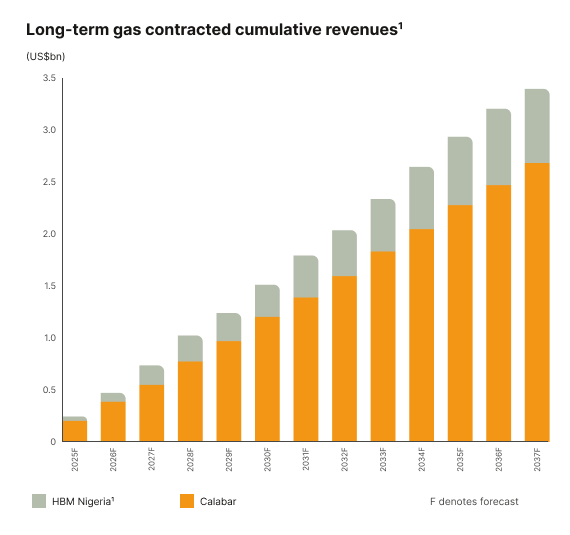
Savannah has three high-quality, high-growth business units in Nigeria, Niger and Cameroon. Our current producing assets providing a predictable base revenue stream are in Nigeria, where future contracted gas revenues are derived from fixed price, long-term gas sales agreements with a weighted average remaining contract life of 13 years and US$3.4 billion of remaining life-of-contract revenues1. Over 90% of our current contracted revenues are with customers providing investment grade2 credit guarantees.
Proven track record of delivery
Savannah has a strong and proven track record of delivering value in a safe and sustainable manner. We benefit from a strong and functionally arranged operating platform, a purposeful performance driven culture, and a highly experienced Board and senior management team.
We have a strong track record of delivering our capital projects on time and budget, of delivering post-acquisition asset performance enhancements and of exploration excellence.
Making a sustainable impact
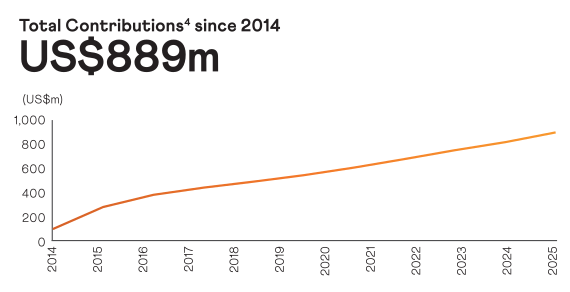
We seek to deliver energy projects in Africa which make meaningful positive socio-economic contributions to our host countries. We strive to manage all of our operations in a safe, secure and environmentally sustainable manner. Our carbon intensity, diversity and local content performance metrics are industry leading. Our sustainability strategy is focused on four key pillars aligned with 13 of the United Nations Sustainable Development Goals.
Strong organic growth potential
In Nigeria, we continue to deliver significant organic growth through a 24-month expansion programme at the Stubb Creek Field, which saw average gross daily production increase by approximately 13% from 2.7 Kbopd in 2024 to 3.0 Kbopd in 2025. The full programme is anticipated to raise gross production to as much as 4.7 Kbopd. During 2025, we also announced a 21% upgrade in 2P Reserves at the Uquo gas field and a 29% upgrade in 2P Reserves at the Stubb Creek oil field. The completion of the Uquo gas compression project in 2025 and the drilling of two gas wells on the Uquo Field this year are designed to support the continued reliable supply of gas to our customers. The Uquo South exploration well was spudded in early August. We are currently completing the well and have discovered gas in most of the targeted reservoirs. Following completion of the well, we will undertake further testing and evaluation to assess the significance and potential resource implications of the discovery.
The Company continues to engage with the Government of Niger in relation to the R1234 PSC and the forward work programme.7 The R3 East development plan has been significantly re-worked since the last published Niger CPR of December 2021, with a plateau production rate of approximately 10 Kbopd now assumed, compared with 5 Kbopd in the previous development case. We continue to develop our portfolio of greenfield wind, solar and hydroelectric renewable energy projects, with our principal focus projects being the up to 250 MW Parc Eolien de la Tarka wind farm project in Niger8 and the up to 95 MW Bini a Warak hybrid hydroelectric and solar project in Cameroon.
Strong inorganic growth potential
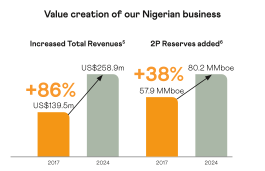
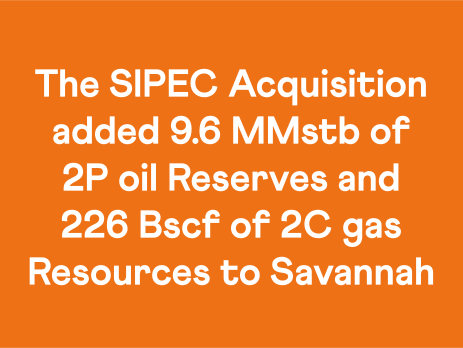
We continue to actively review new acquisition opportunities focused predominantly on: cash-generative, or near-term cash-generative, upstream and midstream assets; and/or “bolt-on” assets for which there is significant synergistic value to our existing operations. In the case of the former, typically larger opportunities, our focus is upon those that are being offered by vendors which are divesting assets for “strategic” reasons and would be unit value per share accretive to Savannah. We see significant value creation potential in such deals, with prime examples including the performance improvements we have delivered in our Nigerian assets post acquisition and the recent SIPEC Acquisition, which has been highly accretive to Group net asset value.
1. Remaining life of contract revenues estimated on a maintenance adjusted take-or-pay basis including contributions from two of our customers: Calabar Generation Company Limited (owner of the Calabar power station), and HBM Nigeria Plc (owner of the Mfamosing cement plant). Note this is not an audited number. Lafarge Africa PLC changed its name to HBM Nigeria PLC on 6 May 2026, following its acquisition by Huaxin Building Materials Group.
2. Investment grade indicates credit support from an entity which holds an investment grade rating from either Standard & Poor’s, Moody’s or Fitch Ratings.
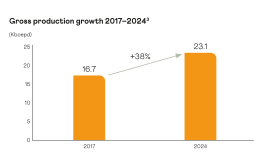
3. In 2017 Savannah entered exclusive discussions to acquire the Nigerian assets, this graph includes the period when Savannah had influence over running the assets before completion of the acquisition.
4. Total contributions to Nigeria and Niger defined as payments to governments, employee salaries and payments to local suppliers and contractors. Where Total Contributions refer to the period 2014–2025 they include contributions to Nigeria during the period pre-acquisition of the Nigerian assets by Savannah.
5. Total Revenues are defined as the total amount of invoiced sales during the period. This number is seen by management as more accurately reflecting the underlying cash generation capacity of the business as opposed to Revenue recognised in the Condensed Consolidated Statement of Comprehensive Income. A detailed explanation of the impact of IFRS 15 revenue recognition rules on our Consolidated Statement of Comprehensive Income is provided in the Financial Review section of the Annual Report and Accounts 2020. Please note that Savannah’s 2024 Total Revenue is an unaudited figure and therefore can be subject to change.
6. For comparison purposes, the production between of the Nigeria CPR dated December 2017 and end of 2024 have been deducted from the 2P Reserves. All 2P Reserves in graph are as at 31 December 2024.
7. These discussions are aimed at resolving disputed issues arising under this contract and notably cover the contractual and operational framework for recommencing activity, including the treatment of periods during which operations have been materially constrained. The Company continues to reserve its rights under the R1234 PSC and is seeking to agree a mutually acceptable basis with the Government for future operations. Work will only recommence on these assets if, and when, the Company reaches such a satisfactory agreement with the Government.
8. The timing and sequencing of further development activities in relation to the Parc Eolien de la Tarka project are expected to be linked to the timing and outcome of the Company’s ongoing discussions with the Government of Niger regarding the R1234 PSC and the potential recommencement of oil activities.